





نيروز الإخبارية :
Abdulhamid Hamid Al-Kba
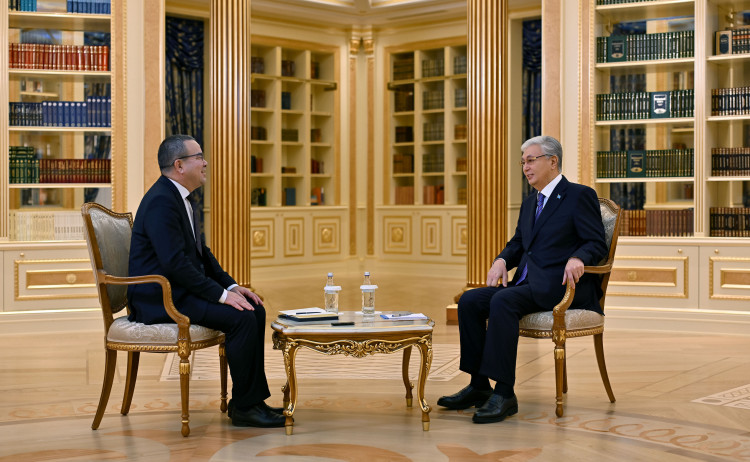
As 2026 begins, the President of Kazakhstan Kassym-Jomart Tokayev grants the newspaper "Turkistan"—one of the country's most historic and influential media outlets—an opportunity for an open and direct dialogue that opens the doors of Akorda Palace wide. This dialogue is not merely a routine annual tradition, but a vibrant and living political document reflecting the transformation of a state advancing with rapid and calculated steps toward an entirely new era. Tokayev, the seasoned diplomat who skillfully blends traditional Eastern pragmatism with a broad global vision, speaks with absolute frankness and without evasion: Kazakhstan has indeed entered a "new phase of modernization," and 2026 will be a truly "pivotal" year, shaping the destiny of future generations and determining the country's position in the new world.The President begins his summary of 2025 with truly unprecedented historic figures: economic growth exceeding 6%, gross domestic product crossing the $300 billion barrier for the first time in the country's history, and per capita income surpassing $15,000. These are not just record achievements for Kazakhstan alone, but for the entire region, placing Astana at the forefront of emerging nations in Central Asia.However, he does not stop at celebration but warns directly and frankly: "Danger lies in the most favorable circumstances," drawing on an ancient Eastern proverb that expresses his constant caution based on long experience. In his view, the foremost challenge is inflation that undermines all gains and erodes citizens' well-being day by day, alongside the urgent need for radical and comprehensive reforms to build a society fundamentally based on justice, law, and daily diligence.Economic Reforms: Toward Fair Taxes and True Social JusticeTokayev delves deeply into the heart of the controversy sparked by the new tax law during the past year, which raised widespread concerns and questions among citizens. The President completely rejects classifying it as a "transient financial campaign" or routine measure, describing it instead as a "comprehensive and radical restructuring" of the entire tax system, aimed primarily at ensuring sustainable and long-term economic growth. He justifies raising the value-added tax—after personally directing its reduction from 20% to 16% to ease the burden—as a precise balance between the necessity of reform and preserving citizens' living standards.The core message Tokayev emphasizes is that taxes are not a heavy burden or punishment but a "modern social contract" linking the citizen and the state: You pay taxes to receive high-quality public services, advanced infrastructure, comprehensive security, and equal opportunities. He explains that previous low utility tariffs were in fact "hidden support for the wealthy and large corporations," not for the poor or middle classes, and that the new differentiated system ("the more you consume, the more you pay") with the introduction of a specific "social consumption standard" will achieve a truly fair distribution of public resources.Here, Tokayev's social philosophy shines clearly: The state is obligated to directly support needy segments in a targeted manner, rather than through indirect support that ends up in the pockets of the powerful and monopolists. The President acknowledges the difficulty of this thorny path but assumes full personal responsibility: "History favors invaders and populists over reformers, but Kazakhstan has no other choice; we must move forward or stagnate."In the energy and utilities sector, Tokayev describes the largest reform since independence as addressing a "complex knot" accumulated over entire decades, where problems were concealed rather than solved. He criticizes previous governments that contented themselves with hiding the gradual collapse of infrastructure, stressing that true modernization goes beyond mere material rebuilding to fundamentally change operational principles, thereby attracting foreign and domestic investments and creating a genuinely competitive market.Artificial Intelligence and Digital Transformation: The Bet on Survival in the New Technological EraPerhaps the most inspiring and ambitious part of the dialogue is Tokayev's explicit declaration that 2026 will officially be the year of "digitalization and artificial intelligence." The President views it as a "shared survival issue" for the entire state in a technological era that rapidly separates leading nations from lagging ones. He praises the current achievements already realized: The Astana Hub complex hosting over 2,000 startups, IT services exports reaching $1 billion, the establishment of a specialized ministry in artificial intelligence, the launch of supercomputers, the issuance of a dedicated AI law, and a specialized research university set to open soon.Tokayev places Kazakhstan at the heart of the fierce global competition between the United States and China, affirming that betting on artificial intelligence is not a luxury or secondary option but an inevitable necessity for transforming the economy and public life entirely. "Our people are intellectually ready for this transformation," he says confidently, pointing to the success of fintech companies in changing citizens' daily lifestyle. This vision reflects a clear long-term ambition: Kazakhstan is no longer merely an exporter of raw materials and oil but aspires to become a global digital power competing with the giants.Nuclear Energy: Correcting a Painful "Historical Paradox"Tokayev devotes prominent and important space to the topic of nuclear energy, describing the construction of new nuclear plants as "correcting a historical paradox" that is illogical: Being a world leader in uranium production without owning a single dedicated nuclear plant. The President links this project to the urgent need for reliable and sustainable energy to support supercomputers, data centers, and advanced industries, seeing it as a golden opportunity to graduate a new generation of engineers and technical intellectuals, which in turn will change the "essence of national policy" and build a specialized class capable of leading the future.Foreign Policy: A Smart Balance in a Turbulent and Changing WorldThe Kazakh President also addresses foreign policy, which witnessed exceptional activity in the second half of 2025, turning Kazakhstan into a true diplomatic center. In addition to Tokayev's multiple visits to Beijing, Washington, Moscow, Ankara, and Tokyo, alongside hosting world leaders in Astana, he affirms that the focus was purely economic, with deals signed exceeding $70 billion in vital sectors.He refers to U.S. President Trump's "logical" strategy pushing traditional globalization into the background, stressing that Kazakhstan is building a society based on justice, law, and order. He rejects the idea of mediating major international conflicts but participates in closed consultations directly at the request of world leaders. This precise and pragmatic balance between Russia, China, and the West is the key to the success of Kazakh foreign policy, transforming the sensitive geopolitical location into a real strategic strength.2026: The Year of Decisive and Pivotal TransformationsPresident Tokayev describes 2026 as "pivotal" in every sense of the word, with an anticipated national referendum on broad constitutional reform that could lead to adopting an entirely new constitution, alongside deeper development of economic reforms and the full launch of digital transformation. He links this to the "Taza Kazakhstan" (Clean Kazakhstan) campaign, which he sees as a profound ideological project embodying purity in minds, intentions, and daily reality. The 35th anniversary of independence will also be an opportunity for objective critical evaluation and setting new long-term plans.In conclusion, Tokayev affirms with confidence that modernization is "radical and irreversible," requiring rapid collective adaptation to the new reality from all citizens. Yet he remains highly optimistic: "Our people, especially our talented and patriotic youth, are fully capable of accomplishing this historic task."Therefore, this dialogue is not just passing words or an official speech; it is a true leadership statement reflecting a statesman bearing full historical responsibility in an era of accelerating and turbulent transformations. Tokayev's Kazakhstan is not a traditional state relying solely on oil and resources but a cohesive and ambitious nation aspiring to leadership in the age of artificial intelligence, social justice, and innovation. In 2026, we will all witness whether this bold vision translates into tangible reality that changes the face of Central Asia entirely and places Kazakhstan at the forefront of emerging nations globally. The stakes are very high, and the national will is greater and stronger.






وكالة نيروز الإخبارية
لا مانع من الاقتباس واعادة النشر شريطة ذكر المصدر { وكالة نيروز الإخبارية } الآراء والتعليقات المنشورة تعبر عن رأي أصحابها فقط. © 2019 - جميع الحقوق محفوظة.
, بريد الكتروني : khalil.aljbour11 [at] gmail.com للإتصال : 0790980000
تصميم و تطوير